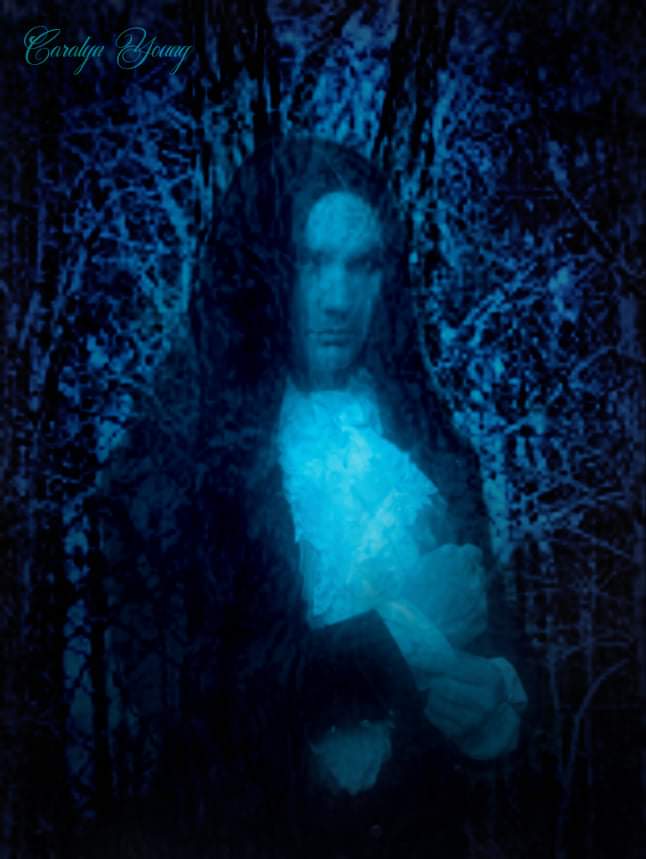
There he was, in all his lacy glory. I’d heard of the viscount, of course, from every local in every cafe and bistro between Paris and Calais. Quite the legend, apparently, that no one outside of France had ever heard.
No one remembered his full title, or even his family name, only that he was a viscount. A fact that had only fueled my dismissal of the story as a joke on gullible tourists, until now. Who could scoff with semi-transparent but gloomy dark eyes boring into one’s soul over the longest cascade of a collar ever seen in 18th century portraits?
“Je vous maudis, traitre!” The voice was bitter, but the lips set and motionless beneath the oddly unstyled black hair that streamed down both sides of a gray face. I glanced around, a shiver uncalled for in the warm summer night air setting my teeth chattering. Even my abominable French understood the word traitor.
“Th-the revolution is over,” I quavered in English. “I’m just a tourist.” Not that there was any point in speaking English to a dead French aristocrat, I thought. Even one that had managed to escape the guillotine only to be thrown from his horse into that widely spreading tree I could see through his face.
“Je vois maudis!” he shrieked, suddenly inches from me with his fist blending with my throat. My breath turned to ice in my chest and for a moment the world became as transparent as the viscount. Then it was over. I smiled with grim satisfaction, quickly twitched the lace on my cuffs back into shape, and turned back toward Paris. The traitors must die under their own cursed blade.
 The Word Worker
Leave a comment