
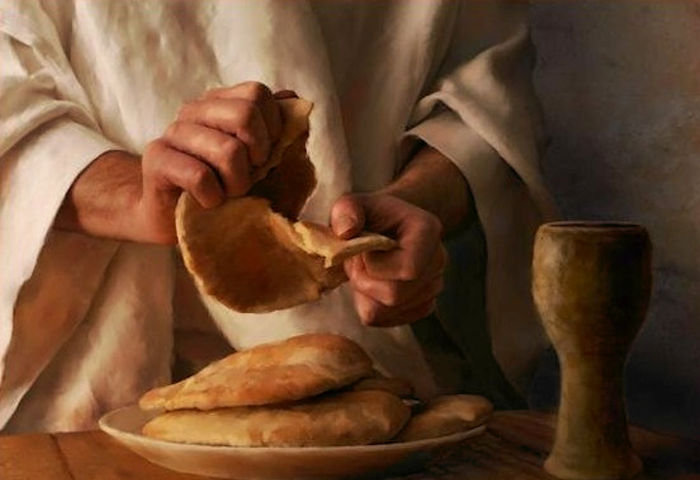
As Jesus prepared to face the cross, He blessed the Passover meal one last time with His closest friends. As he snapped the crisp bread in pieces to share and raised His cup with theirs, He told them what those tokens had always symbolized. It wasn’t the first time He used bread and vintage as symbols for something greater; rather it was a final explanation of God’s grace.
In the book of John, He referred to Himself as the Bread of Life. The same book records a later conversation in which He named Himself the Vine and those faithful to Him branches of that Vine. Just as the liquid pressed from the grapes of a vine fulfilled the covenant, or promise, inherent in the vines nature, the blood that drained from the crucified body of the Christ fulfilled the covenant inherent in His nature as Creator and Savior. He gave Himself to restore life to our starving souls in the same way He provided bread to feed starving bodies in the wilderness.

The apostle Paul wrote to the people of God in the city of Corinth about a terrifying problem they were facing. When these people interacted with each other, gathered together as a group, they began to squabble over differences and gravitate into physically similar subgroups. The rich ignored the poor, those with similar backgrounds ostracized those of other origins, God-given talents and callings were given hierarchy based on human perception and preference. In an effort to recenter their fractured unity, Paul explained that Christ Himself is the body, then explained that each of them with their different backgrounds, social situations, and gifts were parts of Him. Just as all the smaller parts of a human body are necessarily different and yet indispensable to its function, all of the parts of Christ are equally indispensable. In the same conversation, Paul told the confused Corinthians that, although they physically gathered together to feast, they had forgotten in whose body they belonged. They were attempting to feast without seeing the food, and were sickening from spiritual malnourishment.
The Israelites under the Sinai law had been blessed with symbols intended to guard their memories and focus their future. One of these symbols was the Ark of the Covenant bearing the Place of Mercy. It was the token of God’s presence with His people, but before long it had become the focal point of their attention. When war threatened, they carried the Ark itself into battle at the head of their armies as if it’s physical presence alone could win the day. They never thought to speak to the One it represented. When Jesus told His friends to eat the bread and drink from the vine in His memory, He signified an intimacy they would experience with Him that surpassed any experienced since God and man walked the Garden side by side. It was the illustration of an eternal, incomprehensible banquet, just as the Ark had been the illustration of unfathomable protection. For the Corinthians, that illustration had become the idol carried into battle as surely as the Ark had been centuries before.

In the same letter, Paul told the Corinthians to keep the feast. They were bread, but had begun to bloat like yeast bread from their misplaced focus. He warned them that the only way to be part of the Bread was to remember Him, to recenter on Him alone. He was the sacrifice, He was the promise, He was the body. He, and they, were the feast.
The same is true 2000 years later, in a world with the same root distractions and misunderstandings. We, like them, can just as frighteningly become enamored of illustrations and forgetful of their Source. We bite and devour one another over concerns strictly bound to our physical forms and surroundings while feeding ourselves spiritual air. It’s time we learned again to recognize the Body and keep the life-giving Feast.
 The Word Worker


Leave a comment